Color Fill 3D
- 4.6
- Rating
- 100.00M
- Installs
- Free
- Price
 Analysis by App-foxy
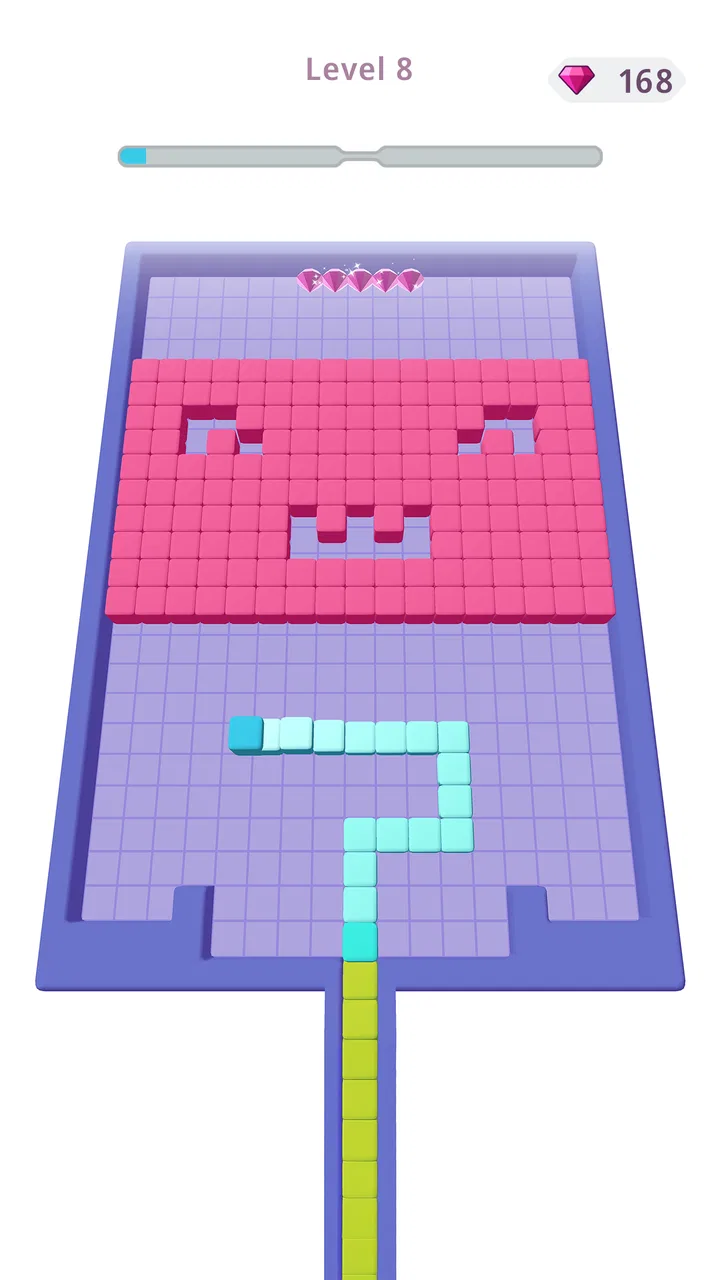
I first understood the appeal of Color Fill 3D within a few seconds: the game asks me to guide a moving stream of color across a board and fill each available cell. The action is simple, but the result is unusually clear. Empty spaces become bright, mistakes are immediately visible, and a completed shape gives me a small burst of satisfaction before the next puzzle appears. It is the kind of puzzle game I can open without preparation, play with one hand, and put down just as quickly.
That simplicity is also the main thing to understand before downloading it. This is not a deep strategy game with a long campaign to study. It is a casual puzzle experience built around short decisions, visual feedback, and the temptation to try one more board. I found it most enjoyable when I wanted a quick mental break rather than a serious challenge. If you like compact mobile games that explain themselves through touch and color, it has an inviting starting point.
How the first move turns an empty board into a puzzle
The first action is deliberately approachable. I touch the play area, guide the color through the available path, and watch the board change as each cell is covered. There is no complicated control scheme to memorize. The game’s central question is easy to grasp: how can I fill the space without leaving an awkward gap or making the route impossible?
You May Also Like

 AccuWeather: Weather Radar
AccuWeather Review: A Quick, Clear Forecast for Everyday Decisions
For everyday plans, the best forecast is the one you can understand quickly. AccuWeather makes rain timing, radar, and local conditions easy to act on, with a few trade-offs.

 Hill Climb Racing
Why Hill Climb Racing Still Turns Crashes Into One More Run
A tiny car, a bumpy hill and one more upgrade: Hill Climb Racing keeps resurfacing because its simple chaos makes every near-miss feel personal.

 AliExpress - Shopping App
AliExpress Makes Global Shopping Feel Personal, but Shoppers Bear the Risk
AliExpress turns a global marketplace into a pocket-sized discovery engine. Its reach is useful, its shopping loop compelling, and its trade-offs easy to miss.

 Lords Mobile: Kingdom Wars
Lords Mobile Is a Kingdom-Building Routine, Not a Quick Match
A case-by-case verdict on the building, battles, device demands, and social commitments that make Lords Mobile rewarding for some players and exhausting for others.

 PDF Scanner app - TapScanner
TapScanner Makes Paperwork Easier to Capture, Check, and Share
TapScanner makes scanning with a phone feel less like a rescue operation and more like a dependable step in getting work done. Its capture tools are useful, though not flawless.

 Block Blast!
 Shows How Much a Puzzle Game Can Leave Out
A quiet grid game shows why puzzle players increasingly value instant clarity, repeatable skill and low-pressure play—and where the genre still needs to catch up.
More From Our News Desk
View All News


That question gives the game more substance than its bright presentation might suggest. A move can look correct at the beginning and still create trouble near the end. I learned to look beyond the next open square and consider how the remaining spaces connect. The best route is not always the most obvious one, especially when the board’s shape encourages me to move quickly instead of planning the whole fill.
The controls suit a phone well. I do not need a virtual joystick, a collection of buttons, or precise timing controls. The interaction feels direct, which makes the game comfortable during a short break on a bus, while waiting for food, or between tasks at home. A realistic use case is a five-minute pause when I want something more engaging than scrolling but do not have enough time for a larger game. I can start a puzzle, focus on one small objective, and stop without losing an entire evening.
That accessibility makes it suitable for a broad audience. The content rating is Everyone, and the basic idea is clear enough for younger players while still giving adults a modest logic exercise. I would still expect the experience to appeal most to people who enjoy repetition and quick visual rewards. Players looking for a story, character development, or a detailed world will find very little here to hold their attention.
The developer behind it is CASUAL AZUR GAMES, and the presentation reflects a focus on immediate play rather than lengthy explanation. I appreciate that the game does not make me work through a tutorial-heavy opening before allowing the main interaction. The first puzzle teaches the mechanic by letting me perform it.
Why the route matters more than the color
The color is the most noticeable part of the experience, but the real puzzle is spatial planning. I found it useful to divide the board mentally into sections instead of staring at the entire shape as one problem. Filling a narrow corner early can either secure a difficult area or block the route needed to reach it later. That makes the order of movement more important than simply covering the largest visible patch first.
One practical habit helped me avoid careless failures: before moving, I checked the tightest corners and the cells with only one realistic entrance. Those spaces act like anchors. If I leave them until the end, I may discover that the remaining route cannot reach them cleanly. This is a small but meaningful improvement over playing by instinct, and it gives the simple loop a little more thought.
I also learned not to rush just because the game looks relaxed. The vivid board and quick movement can encourage automatic gestures, yet a moment of planning often saves a restart. That contrast is one of the better design choices here: the game feels casual on the surface, but it rewards a player who pauses long enough to read the shape.
The feedback rhythm keeps the loop moving
Every successful section of the route produces immediate feedback. I see the color spread, the empty area shrink, and the board become more complete. That visual response is the heartbeat of the game. There is no need to wait for a complicated calculation to know whether my action helped. The board itself answers me.
This rhythm follows a clear pattern: action, visible progress, a small sense of reward, and then another decision. Because the feedback arrives so quickly, even a modest move feels worthwhile. I never have to wonder whether I made progress. That clarity is especially useful on a small screen, where a complicated interface would get in the way of the puzzle.
The feedback also makes mistakes understandable. When a route stops being useful or leaves a section inaccessible, the shape of the board shows the problem. I can usually identify the bad decision instead of blaming the controls. That distinction matters. A puzzle feels fairer when failure comes from my planning rather than from unclear input.
At the same time, the visual simplicity can become repetitive. The same basic relationship between empty cells and filled color remains the focus from one puzzle to the next. I enjoyed that consistency during short sessions, but I could also see it becoming less exciting for someone who needs constant new mechanics. This is a game about refining a familiar action, not discovering a large set of systems.
For me, the strongest feedback comes when a nearly completed board suddenly makes sense. A route that looked messy becomes orderly, the final gaps close, and the entire shape is filled. That moment is small, but it explains why I often wanted to begin another round. The game does not need a large narrative payoff when the board provides its own visual conclusion.
Small decisions that improve consistency
I found three habits particularly useful. First, I avoid committing to a long route before checking whether it cuts off a corner. Second, I treat narrow passages as valuable connections rather than ordinary cells. Third, when a board looks confusing, I focus on the last few empty spaces and work backward mentally. This often reveals which area needs to remain reachable.
These are not advanced controls or hidden menus; they are ways of reading the puzzle more effectively. They also show where the game’s genuine value lies. The store summary presents a colorful filling concept, but the useful skill is learning to predict the consequences of a route. That makes the game a better fit for someone who enjoys light spatial reasoning than for someone who only wants a visual toy.
Another practical tip is to play with a deliberate pace. The game’s short format makes it easy to tap quickly, especially when I think I have already solved the board. Slowing down before the final movement reduces avoidable errors. I would not call the puzzles demanding in the same way as a traditional brain-training title, but they can still punish an impulsive gesture.
The reward is modest, immediate, and easy to chase
The main reward is completion itself. Filling the board gives me a clean visual finish and the feeling that I have solved a contained problem. That is enough to make one round satisfying, particularly when I had to correct my initial plan. The game’s appeal comes from the short distance between effort and payoff.
It is also a good example of why mobile puzzle loops can be effective without a complicated progression system. I do not need to remember a storyline or manage a large collection before I can enjoy the next moment. The reward arrives from seeing the board transformed by my own route. For a quick break, that direct connection works better for me than a system that asks me to maintain several long-term objectives.
However, players should have realistic expectations about the type of reward involved. This is not the sort of game I would choose for deep achievement hunting or elaborate strategic mastery. The satisfaction is closer to finishing a small brain teaser or tidying a messy pattern. If that sounds appealing, the loop can be pleasantly calming. If you want a powerful sense of progression, the experience may feel thin.
The game is free to play, which makes trying it straightforward. It includes in-app purchases ranging from $0.99 to $99.99 per item. I would approach those purchases carefully and decide whether the short-session loop is genuinely holding my attention before spending anything. The free entry is useful because the central mechanic can be judged quickly; there is no need to commit financially just to discover whether filling boards is your kind of relaxation.
Its popularity suggests that the format has reached a large audience. The game has an average rating of 4.6 from around 926 thousand ratings and has passed 100 million installs. Those figures do not change my personal experience, but they do indicate that the basic idea has broad appeal. I would still treat popularity as a starting point rather than a guarantee, because the same repetition that comforts one player may bore another.
Where it fits among other puzzle choices
Compared with match-three games, this feels less dependent on creating chains and more focused on route planning. I am not scanning for identical symbols or waiting for a cascade. Compared with Sudoku or traditional number puzzles, it is more visual and less demanding in terms of written logic. Compared with maze games, it is more compact because the objective is to fill the board rather than simply reach an exit.
That position makes it useful when I want a puzzle that sits between a toy and a brain teaser. It asks me to think, but it does not require the concentration of a long logic session. A dedicated nonogram, Sudoku, or advanced maze app would be a better choice if I wanted layered difficulty, detailed solving tools, or a more substantial sense of mastery. I prefer this game when convenience and immediate feedback matter more than depth.
The comparison also highlights a limitation: the core action does not change dramatically. A traditional puzzle collection can offer several rule sets, while this game builds variety mainly through the arrangement of the board. That can be enough for short visits, but it may not sustain players who need a constant stream of new ideas.
Resetting after a mistake is part of the attraction
When a route goes wrong, the natural response is to reset and try again. I did not experience that restart as a major setback because the puzzle is small enough to understand quickly. The previous attempt becomes information: I learn which passage I closed, which corner I ignored, or where I moved too aggressively.
This reset is central to the loop. The game gives me a clear problem, lets me act, shows the result, and then invites a cleaner attempt. That structure makes failure less discouraging than it might be in a long level with a large time investment. I can experiment without feeling that I have wasted a substantial session.
There is a trade-off, though. A low-cost restart can encourage trial and error instead of careful planning. I sometimes caught myself making a quick move simply to see what would happen, knowing I could begin again. For players who enjoy solving through experimentation, that is convenient. For players who prefer a puzzle to demand one carefully reasoned solution, it may reduce the tension.
My advice is to use the reset as a learning tool rather than an automatic escape. After a failed attempt, I try to identify the exact decision that caused the problem before repeating the board. That turns repetition into improvement. Without that small pause, the game can become a cycle of random gestures followed by another restart.
The reset also makes the game suitable for interrupted play. If I am called away after a failed attempt, I do not feel tied to a long campaign or worried about losing a complicated setup. The format is forgiving of ordinary phone use, where sessions are often broken by messages, conversations, or changing plans.
Who should play and who should skip it
I recommend it to players who want colorful, low-pressure puzzles with a direct touch response. It works particularly well for a short commute, a quiet pause before bed, or a few minutes when I need to shift my attention away from work. It is also a reasonable choice for families because the basic objective is easy to explain and the age rating is Everyone.
I would be more cautious about recommending it to someone who dislikes repeated board-filling tasks. If you need an evolving story, character goals, competitive depth, or a wide range of puzzle types, another game will probably serve you better. The same applies if you want a completely hands-off relaxation app; this still asks you to plan routes and pay attention to blocked spaces.
Device compatibility is fairly broad: the listed minimum operating system is Android 7.0, and the current version is 300000.9.0. That makes it accessible to many Android users, although the practical experience will still depend on the phone’s screen size and responsiveness. On a smaller display, I would take extra care with gestures near tight corners, since the game’s simple controls leave little room for correcting an imprecise touch.
My verdict on the action-feedback-reward-reset loop
After spending time with it, I see Color Fill 3D as a focused casual puzzle rather than a full-scale game collection. Its loop is easy to describe and easy to feel: I choose a route, watch color occupy the board, enjoy the clean finish, and restart when my plan fails. The reason to begin another session is not a dramatic unlock or a complicated objective. It is the desire to solve one more shape a little more neatly.
That focus is both its strength and its boundary. The game is friendly, quick to understand, and satisfying in short bursts. Its visual feedback is immediate, its controls are approachable, and the reset cycle makes mistakes manageable. I especially like the way a simple board can reward a moment of foresight, such as protecting a narrow passage or saving a corner for the right time.
On the other hand, the repeated structure may wear thin, and the game does not replace deeper puzzle formats when I want variety or sustained challenge. I would download it for convenient, colorful breaks, not as my only puzzle game. The free price makes that decision easy, while the available purchases mean I would keep my spending deliberate.
Overall, I think it succeeds because it respects the short attention span of a phone session without making every move meaningless. When I want a compact spatial challenge that gives me an obvious result and a quick chance to improve, it is a good companion. When I want a rich campaign or a demanding logic workout, I reach for a different kind of puzzle.
FAQs for Color Fill 3D
01What is the main objective of Color Fill 3D?
Color Fill 3D is a puzzle game where the primary objective is to fill the entire grid with a single color. Players swipe to move and paint the blocks, avoiding obstacles and strategically planning their moves to complete each level. It’s a fun and engaging way to test your puzzle-solving skills.
02Is Color Fill 3D free to play, and does it contain ads?
Color Fill 3D is free to download and play, but it does contain in-game advertisements. Players can choose to watch ads for hints or to earn extra lives. For those who prefer an ad-free experience, there may be in-app purchase options available to remove ads.
03What are the system requirements for installing Color Fill 3D?
Color Fill 3D requires a device running Android 4.4 or later, or iOS 9.0 or later. It is compatible with most smartphones and tablets, ensuring a smooth gameplay experience. Make sure your device has adequate storage space and is updated to the latest OS version for optimal performance.
04Are there any in-app purchases in Color Fill 3D?
Yes, Color Fill 3D offers in-app purchases. Players can buy items such as additional moves, hints, or ad removal to enhance their gameplay experience. While the game can be enjoyed without spending money, these purchases can help players progress more quickly or enjoy uninterrupted play.
05How challenging is Color Fill 3D, and is it suitable for all ages?
Color Fill 3D starts with simple levels that gradually increase in difficulty, making it accessible to players of all ages. The game is designed to be challenging yet relaxing, with no time limits, allowing players to think strategically at their own pace. It's a great choice for both kids and adults looking for a brain-teasing puzzle game.
Pros
- Engaging and addictive gameplay.
- Simple controls for easy play.
- Visually appealing graphics.
- Lightweight
- quick download.
- Frequent updates with new levels.
Cons
- Can become repetitive over time.
- Contains in-app purchases.
- Ads can be intrusive.
- No multiplayer mode available.
- Limited customization options.

Color Fill 3D
Gallery